
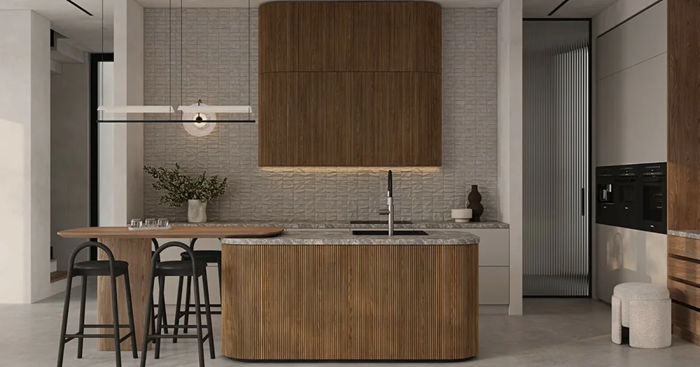
Veneer kitchens are prized for the expressive texture of natural wood, a rich palette of shades, and a refined appearance—all at a more affordable price point than solid wood.
Veneer complements both modern and classic interiors, offering the character of wood-faced cabinetry while maintaining dimensional stability when properly cared for.
When making a choice, it is important to consider the substrate (MDF or particleboard), the type of veneer and protective finish, resistance to moisture and stains, and the quality of edge banding and hardware. To ensure the result perfectly matches the layout and style, many consider custom kitchens in Chisinau as a convenient way to tailor the configuration, materials, and colors to a specific space.
Practical benefits of veneered fronts
When manufactured and assembled correctly, veneer serves as a reliable decorative finish: it preserves the natural wood grain, allows for color matching with the interior, and requires no complex maintenance. The result is a “wood” look for the cabinetry without the temperamental nature of solid wood.
Daily benefits of veneer in the kitchen
Natural aesthetics without breaking the budget – veneer captures the natural grain pattern, the “warm” feel of the surface, and sophisticated undertones. At the same time, the cost is usually significantly lower than solid wood fronts, yet the appearance is closer to natural wood than most imitations.
Stability and predictability – veneered fronts generally react less to fluctuations in the indoor climate than solid wood ones. This is particularly important near the stove, oven, and sink, where operating conditions constantly change. Ease of maintenance – daily cleaning requires nothing more than a soft cloth and neutral cleaning agents. With proper care, veneered fronts retain their pristine appearance longer: minor fingerprints and light smudges are less noticeable against the wood grain than on high-gloss surfaces.
- Tactile appeal: the surface feels “alive” and warm to the touch, enhancing the kitchen’s overall comfort.
- Versatility: veneer allows you to select the wood species, grain direction, and shade to match your interior style—ranging from calm, light tones to deep, dark hues.
- Repairability: localized defects on individual elements can sometimes be easier to mask or restore compared to foil-wrapped finishes, where damage often stands out more starkly.
- Durability and long-term practical benefits: in real-world use, the fact that veneered fronts retain a “premium” look over time is highly valued; the wood grain never goes out of style, and the kitchen’s overall aesthetic remains relevant even when decor or appliances are updated. Furthermore, veneer pairs harmoniously with stone, glass, and metal, making it easier to refresh the interior without replacing the entire cabinetry set.
A sensible balance – using veneer provides the feel of a natural material while avoiding extremes: the high maintenance requirements of solid wood and the “plastic” look associated with certain synthetic finishes. When choosing a kitchen, this translates to a more worry-free experience and less concern about the appearance of the fronts during daily use.